




Woehl Stadium: The Home of Our Youthful Dreams
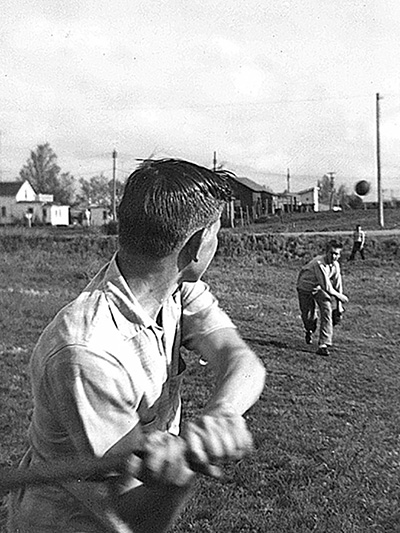
Whenever I feel the warm sun on my neck, feel a gentle breeze playing through my hair, or smell the musky earth, I am reminded of Woehl Stadium and the days of my youth in Wishek, N.D.
In 1962, when I just knew I would soon replace Mickey Mantle in center field for the Yankees, I decided we kids needed a better baseball diamond than the small empty lots we rotated among in our town of 1,400 people. We needed a professional baseball stadium to ready me to play in New York.
First we needed a permanent site. We chose an empty lot next to my cousin Jim Woehl's garage at the end of town.
Then we determined what we needed to make a stadium. We started with a dugout. We shoveled a 6 x 3-foot rectangle 2 feet deep, sliced off long sides of a Kelvinator refrigerator box, and slid the remainder into the hole. Bingo! We had a dugout with an earthen floor.
We made baselines to first and third by cutting the grass along those routes. Next was a bullpen, and then a raised pitcher's mound. We used a piece of wood for first base, a yellowed stop sign for second, and gunnysack for third.
Home plate was our pride and joy. It was wrought of slats of wood nailed tightly together in shop class and then fitted into a hole we dug the ground.
We rarely had enough players to field a catcher, so the batter had to chase missed pitches, delaying the game. Thus, on the rising ground behind home plate we built a backstop consisting of two wooden posts with chicken wire nailed between them. Missed balls struck the wire and rolled down the slope to the batter's feet. It was perfect!
This was the beginning of our professional baseball stadium! It wasn't a stadium, of course -- not a proper one, but to us, it was every bit as good as major league stadiums.
I was proud and elated. I imagined the rest yet to come: a scoreboard, an outfield fence, spectator stands -- everything.
While working for the school janitor, I saw a teacher operate the ditto machine in the high school basement. I also knew the back door was often unlocked during the summer. I saw an opportunity to make professional score sheets for our games.
After delivering newspapers, I slipped in the back door of the high school and dashed down to the machine, where I borrowed two ditto masters. At home, I drew two baseball score sheets, one with the New York Yankee lineup listed -- Bobby Richardson, Tony Kubek, Roger Maris (from Fargo, N.D.!), Mickey Mantle, and so on. My team would use these sheets: my brother was Bobby Richardson/Ronnie Vossler, I was Mickey Mantle/Billy Vossler, and so on. Oddly, often Richardson/Ronnie hit singles in games, and Mantle/Billy often hit homers at Woehl Stadium, just like both players did in American League games. The other score sheet had the actual names of players not on my team.
The next day, back at school, I took a deep breath and pulled open the back door. I nervously tiptoed down the steps. What would I say if I were caught? "Hi, I'm using school equipment to make baseball score sheets." Mom would have a conniption if she found out what I was doing.
It took me a minute to figure out how to attach the master to the drum. I listened to make sure there was no one around, but I could only hear the thumping of my heart. It would be much more dangerous now because of the noise of the machine. I grabbed the handle and turned the drum. Oops! The paper tray was empty.
I found paper in the cabinet below and slid paper into the tray. I listened again. There were no footsteps, no doors slamming, no talking, nothing.
I cranked the drum and a copy of my Yankees score sheet appeared. Yay! I made 30 copies while the noise boomed and echoed around the room. How could the whole world not hear? I breathed hard.
I changed the master and dittoed 30 other score sheets. With two stacks of score sheets in hand, I headed for the stairs as fast and quietly as I could.
Halfway up, I stopped. I'd forgotten the masters! Then I heard the click of the outer door upstairs. Voices! My stack of score sheets started coming loose, but I grappled them before they fell.
I desperately needed a hiding place, but not much was available, so I crouched behind the ditto cabinet.
I heard feet clump on the stairs. My heart nearly jumped out of my chest. I was going to prison for sure.
I heard more footsteps, but they weren't coming nearer. Instead, they were receding, going up to the second floor.
I held my breath and waited a few more seconds. I poked my head out and glanced up the steps. Seeing no one, I ran to the stairs. But then I remembered the masters, so I ran back and grabbed them. I raced up the stairs, flinging caution aside. Nobody yelled, "Billy Vossler, what are you doing here with those sheets of paper?"
Darting my eyes around like a criminal, I raced outside. I dropped everything into my bicycle basket and hopped on my bike. I pedaled away hard. There were no cries of "Thief!" and no police sirens. A block later I knew I was safe!
For a while, for each game at Woehl Stadium, I tallied up at bats and hits and batting averages. It was a lot of work, and most players weren't interested anyway. It was a huge comedown for me. So, even after all the dangers I'd encountered to make the sheets, I quit using them.
There was no money for bats and balls, so all our equipment was wounded relics. I clearly remember the thrill I felt when a bat splintered during an American Legion or town team baseball game. We used the same balls forever, stitching the leather hides together using clear fishing line.
And so, we chose teams day after day and week after week, and we played and played and played.
But then the years flowed around us and tugged our youth away. Our interests turned in other directions. Our education drifted us in different rivers and streams.
So now all that is left of those days at Woehl Stadium are the rich memories of youngsters playing the great American game and having great fun. And that's something that can never be taken away from us.

Follow Us On ...